


Planning a Private Nature Trip to Colombia: The Complete 2026 Guide
Never trust the map entirely when planning a journey through Colombia.
Colombia holds more bird species than any country on Earth, stretches from Caribbean coastline to Amazon rainforest to snow-capped peaks within a single day’s drive in some regions, and remains, for many travelers, wide open — not overrun. But that same diversity makes it one of the hardest countries to plan independently. Distances that look short on a map often take hours on mountain roads. Regions with world-class lodges sit twenty minutes from areas with none. And the best experiences rarely show up in a Google Maps search.
This guide breaks down what actually matters when planning a private, nature-focused trip to Colombia: where to go, when to go, how long you need, and what separates a trip that flows from one that fights you at every turn.
Why Colombia Works So Well for a Private Nature Trip
Most countries with this level of biodiversity require long transfers between regions, think days of travel between rainforest and mountains. Colombia compresses an unusual amount of ecological range into a relatively small footprint. In a two-week trip, it’s realistic to move between cloud forest, coffee highlands, Caribbean coast, and dry tropical forest without the exhausting long-haul transfers common in, say, East Africa or Southeast Asia.
That compactness is exactly why private planning matters here. Public transport and group tours are built around the handful of stops everyone already knows, Cartagena’s old town, a coffee farm near Salento, maybe a short hike. They’re not built to string together the quieter, higher-value regions in a way that actually flows.
When to Go
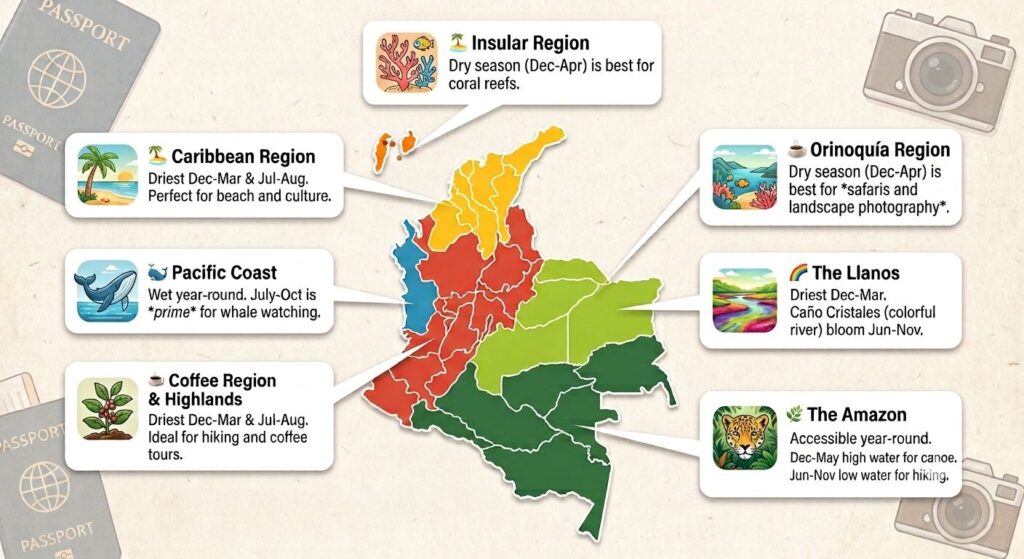
Colombia doesn’t have one single high season, because its regions run on different climate and ecological patterns:
- Tayrona and the Sierra Nevada: driest and most reliable from December to March and again in July–August; Tayrona occasionally closes for short ecological rest periods, worth checking before locking dates.
- Caño Cristales: only worth visiting during the bloom window, roughly June through November, with July to September generally considered peak color.
- The Amazon: a year-round destination, though water levels shift what’s accessible — high water (roughly December–May) favors canoe exploration of flooded forest, low water (June–November) opens up more hiking trails.
- Coffee Region: relatively dry year-round, with the driest stretches from December to March and July to August.
- Pacific Coast: wet most of the year — it’s a rainforest — but July–October is prime for whale watching despite the rain.
- Llanos: dry season, roughly December to March, concentrates wildlife around remaining water sources and makes for the strongest sightings.
For a multi-region trip touching several of these, December through March offers the broadest overlap — though Caño Cristales specifically requires shifting toward the June–September window regardless of what else is on the itinerary.
Why Private Transport Isn’t Optional Here
Several of Colombia’s best nature destinations simply aren’t reachable through normal channels: Caño Cristales requires a small charter flight and a locally arranged approach; the Amazon requires a flight to Leticia followed by river transport; the Sierra Nevada’s more remote lodges are well beyond where a standard taxi will take you. Even in more accessible regions like the Coffee Region, mountain roads can take considerably longer than map distance suggests.
A private-transport itinerary, sequenced around realistic flight schedules and transfer windows, is what makes it possible to combine several of these regions in a single two-to-three-week trip rather than requiring separate trips for each.
The Regions Worth Building a Trip Around
Tayrona and the Sierra Nevada de Santa Marta
Tayrona National Park is Colombia’s best-known coastal wilderness — palm-lined beaches backed directly by dense jungle, with no long buildup required to reach it from Santa Marta. It sits at the edge of the Sierra Nevada de Santa Marta, the world’s highest coastal mountain range, which rises from sea level to snow-capped peaks in under 45 kilometers. The wider Sierra is also home to four Indigenous groups — the Kogi, Arhuaco, Wiwa, and Kankuamo — and to Ciudad Perdida, a pre-Columbian city older than Machu Picchu, reachable by multi-day trek or, for travelers with less time, by helicopter.
Best for: travelers who want an iconic Caribbean-meets-jungle landscape paired with real cultural and archaeological depth. Realistic time needed: 3–5 days.
The Colombian Amazon
Colombia’s Amazon region — centered around Leticia, where Colombia, Brazil, and Peru meet — offers a genuinely different experience from Amazon access points in Brazil or Peru: fewer visitors, more intimate lodges, and access to both flooded forest and terra firme jungle within short boat rides. Pink river dolphins, hundreds of bird species, and Indigenous-led community visits are all realistic in a focused multi-day stay.
Best for: travelers who want serious rainforest immersion without the more built-up infrastructure of other Amazon gateways. Realistic time needed: 4–5 days, given the flight time required to reach Leticia.
Caño Cristales
Often called the “River of Five Colors,” Caño Cristales owes its striking reds, yellows, and greens to an endemic aquatic plant that blooms for a narrow window each year. It sits inside Serranía de la Macarena National Park, an isolated area accessible only by small aircraft to the nearby town of La Macarena, followed by a private guided approach — there’s no version of visiting this well without local logistics handled in advance.
Best for: travelers prioritizing a genuinely rare, weather- and season-dependent natural phenomenon. Realistic time needed: 2–3 days, timed carefully around the bloom season (roughly June through November, peaking July–September).
The Coffee Region (Eje Cafetero)
Rolling hills covered in coffee, wax palms taller than most buildings, and a slower pace of life define this region. It’s also where Colombia’s boutique hotel scene is strongest — restored haciendas, working coffee farms with a handful of rooms, and small hotels run by families who’ve owned the land for generations.
Best for: travelers who want scenery, food, and a slower rhythm without long driving days. Realistic time needed: 3–4 days.
The Pacific Coast
One of the wettest, most biodiverse regions on the planet, and among the least visited by international travelers relative to its natural value. Humpback whales migrate along this coast roughly July through October. Infrastructure here is minimal by design — this is where private logistics stop being a luxury and start being the only reliable way to see the region properly.
Best for: travelers prioritizing genuine remoteness and wildlife over polish and predictability. Realistic time needed: 3–4 days, ideally during whale season.
The Llanos (Eastern Plains)
Colombia’s vast tropical grasslands, closer in feel to the African savanna than to anywhere else in South America. Wildlife density here — capybaras, anacondas, hundreds of bird species, and healthy jaguar populations in the right areas — rivals better-known destinations at a fraction of the visitor traffic.
Best for: serious wildlife travelers and photographers. Realistic time needed: 3–4 days.
What to Look for in Lodging
Colombia’s boutique hotel and eco-lodge scene has grown quickly, which is good news for travelers but makes it harder to tell an exceptional property from a well-photographed one. A few things worth checking before booking:
- Ownership and size. Independently owned properties with a small number of rooms tend to offer more consistent, personal service than larger operations marketed as “boutique.”
- Location relative to activities, not just relative to a town. A lodge that’s a 20-minute boat ride from the flooded forest you came to see, or a lodge that’s genuinely inside Tayrona rather than at its edge, changes the entire rhythm of a day.
- Guide relationships. The best lodges work with the same local, bilingual guides regularly rather than rotating through whoever’s available — that continuity shows up in the quality of the experience, especially in the Amazon and Caño Cristales, where terrain knowledge is safety-relevant, not just nice to have.
Do You Need a Bilingual Guide?
For city stops, not always. For nature-focused regions — and especially for the Amazon, Caño Cristales, and the more remote parts of the Sierra Nevada — almost always yes, and not only for translation. Local, bilingual guides bring context no guidebook carries: which trail has the best light at sunrise in Tayrona, which family in the Amazon still fishes using traditional methods, why the colors at Caño Cristales peak in one specific week rather than another. That knowledge shapes the entire experience, not just the logistics of getting there.
Planning This Yourself vs. Working With a Specialist
It’s entirely possible to book flights, hotels, and day tours independently for the more accessible parts of this itinerary, Tayrona and the Coffee Region, in particular. What’s harder to replicate independently is everything involving Caño Cristales and the Amazon: charter flight timing, seasonal bloom windows, permits, and lodges that require advance coordination rather than a same-week booking. It’s also harder to replicate the sequencing judgment, knowing which regions pair well given realistic transfer times, and having a local guide network deep enough to adjust in real time if weather or road conditions shift a plan mid-trip.
That’s the gap a specialist operator fills: not access to places you couldn’t eventually find yourself, but the judgment, timing, and local relationships that turn a list of great destinations into a trip that actually works.
Circling Colombia designs private, nature-focused journeys across Tayrona, the Colombian Amazon, Caño Cristales, the Coffee Region, the Pacific Coast, and the Llanos, built around boutique lodging, private transport, and bilingual local guides. If you're planning a trip like the one described above, [get in touch] to start designing your route.
Luisa Puerta