


Introduction
Never trust the map entirely when planning a journey through Colombia.
It is probably the very first piece of advice I give anyone visiting the country.
On paper, Bogotá, Villa de Leyva, Barichara, and Bucaramanga appear to sit comfortably within reach of one another. But the moment you begin winding through the Eastern Andes, you quickly discover that Colombia is not measured in miles or kilometers.
It is measured in mountains.
In changing climates.
In roads that climb into misty highlands, descend into warm river valleys, and pass through villages where someone always seems ready to offer you a cup of coffee or point you in the right direction.
After traveling this route countless times as a guide, and after countless conversations with visitors from Europe, North America, Australia, and across Latin America, I have come to a simple conclusion:
There is no single way to experience it.
There are three.
And none is inherently better than the others.
Everything depends on a far more important question:
What does saving time actually mean to you?
For some travelers, saving time means catching a flight and making the most of every available hour. For others, it means driving at an unhurried pace, knowing that the journey begins long before reaching the destination.
I have met travelers who regretted spending too many hours on the road.
But I have met far more who wished they had slowed down instead of flying over some of Colombia’s most extraordinary landscapes.
This article is not about telling you which route is best.
It is about helping you discover which one is best for you.
Before Choosing Your Route, Understand Colombia’s Geography
Most travelers look at a map of Colombia and reach the same conclusion: Bogotá, Villa de Leyva, Barichara, and Bucaramanga all seem surprisingly close to one another.
In a country with flat terrain and wide highways, you could probably cover that distance in just a few hours.
Colombia is different.
The Eastern Andes run the length of this route, shaping every mile of the journey. Roads wind along mountain ridges, climb into cool highlands, descend into warm valleys, and adapt constantly to the landscape. Every ascent, every descent, and every bend in the road becomes part of the experience.
In just a few days, you will travel from Bogotá’s 2,640 meters (8,660 feet) above sea level to Bucaramanga’s 960 meters (3,150 feet). The temperature will change. So will the vegetation, the local cuisine, and even the pace of life in the towns you pass through.
It is one of the things that surprises first-time visitors to Colombia the most.
You are not simply traveling between cities.
You are crossing entirely different ecosystems.
Along the way, you will discover the high plains of Cundinamarca and Boyacá, colonial towns that seem untouched by time, mountain landscapes stretching far beyond the horizon, and finally the dramatic canyons and fertile valleys of Santander, where the air grows warmer and the scenery transforms once again.
There is a moment, especially after leaving Boyacá behind and entering Santander, when the Eastern Andes seem almost endless. For several miles, you can look east or west and see nothing but mountain ranges fading into the distance, one after another.
It is one of those landscapes that no photograph ever quite manages to capture.
That is why I always say that, along this route, the journey is every bit as rewarding as the destination.
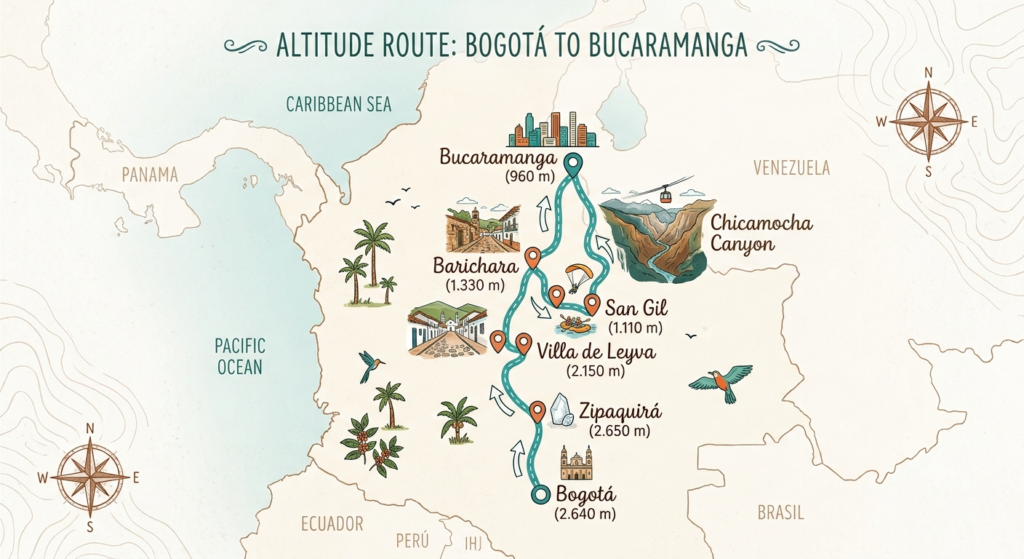
The map below highlights the main stops along the way, their approximate elevations, and the typical driving times between them, giving you a clearer picture of the route before deciding which itinerary best matches your travel style.
Approximate Elevations
Bogotá: 2,640 m (8,660 ft)
Zipaquirá: 2,650 m (8,694 ft)
Villa de Leyva: 2,150 m (7,054 ft)
Iguaque Lagoon: 3,800 m (12,467 ft)
Barichara: 1,330 m (4,364 ft)
San Gil: 1,110 m (3,642 ft)
Chicamocha Canyon: approximately 900–1,500 m (2,950–4,920 ft)
Bucaramanga: 960 m (3,150 ft)
One final piece of advice before you continue: travel times in Colombia are always approximate. A stop for coffee, an unexpected viewpoint, or a conversation with a local can easily reshape the rhythm of your day. If your schedule allows, leave room for spontaneity. More often than not, the most memorable moments are the ones you never planned for.
Option 1: For Travelers Who Want to Discover Colombia Without Wasting a Single Day
Some travelers have only a few days to explore Colombia, but they still want to experience some of the country’s most iconic destinations.
If that sounds like you, this is probably the itinerary I would recommend.
The idea is simple: make the most of every day without ever feeling as though your vacation has become a race against the clock.
The only real trade-off is skipping one of Colombia’s most scenic road journeys. In return, you’ll gain something many travelers value even more: extra time to truly enjoy each destination instead of simply passing through it.
Day 1: The Perfect Introduction to Colombia
I like to begin this journey with a visit to the Salt Cathedral of Zipaquirá, widely regarded as one of Colombia’s most remarkable feats of engineering.
The transformation begins almost as soon as you leave Bogotá. In less than an hour, the capital’s busy streets give way to the cool highlands of Cundinamarca and Boyacá, a landscape of fertile farmland, rolling hills, and small colonial towns that seem to preserve a slower rhythm of life.
Most visitors spend around five hours exploring both the Salt Cathedral and Zipaquirá’s historic center, leaving plenty of time to return to Bogotá, settle into your hotel, and enjoy a relaxed dinner before the next stage of the journey begins.
If you are traveling with a private guide and driver, the day unfolds at an easy pace, without the need to pack and unpack or change hotels immediately after an international flight—a small detail that many travelers end up appreciating more than they expected.
Days 2–4: Barichara and the Soul of Santander
The following morning, a private charter flight to San Gil dramatically reduces travel time, allowing you to spend nearly your entire trip experiencing the destination rather than getting there.
From San Gil, a private vehicle continues to Barichara.
Many Colombians consider it the most beautiful town in the country.
After visiting it countless times, I completely understand why.
Life moves differently here.
Stone-paved streets, whitewashed houses framed by handcrafted wooden doors, quiet plazas, and peaceful afternoons create an atmosphere that feels worlds away from Colombia’s larger cities.
Over the next two or three nights, you’ll have the freedom to explore the region at your own pace.
Some of my favorite experiences include walking the historic Camino Real to the village of Guane, soaring above the Chicamocha Canyon on a paragliding flight, and discovering Santander’s distinctive cuisine in restaurants where traditional recipes meet contemporary cooking.
Barichara is also an exceptional place to stay in a boutique hotel, enjoy a wellness experience, or simply spend an afternoon wandering its streets without any particular destination in mind.
More often than not, those unplanned moments become the ones people remember most.
Who Is This Route Best For?
I usually recommend this itinerary to couples, families, and travelers with four or five days available who are looking for a comfortable, personalized journey with very few hotel changes.
It is not the most comprehensive way to explore the region.
But when every day of your trip matters, it is one of the most rewarding.
What You’ll Miss
Choosing this itinerary means skipping the drive between Boyacá and Santander, one of the most spectacular stretches of road in Colombia’s Eastern Andes.
If you love road trips, scenic drives, or stopping in small towns along the way, the second itinerary will probably suit you better.
But if your priority is making the most of your time without compromising on comfort, this is a remarkably difficult option to beat.
Option 2: The Route I Would Choose
If I could recommend just one way to explore this part of Colombia, this would probably be it.
It is not the fastest.
Nor is it the least expensive.
But it offers, in my opinion, the finest balance of history, landscapes, local cuisine, and some of the most beautiful towns in the country.
This is an itinerary for travelers who believe that the journey itself deserves as much attention as the destination.
Days 1–2: From Bogotá to Villa de Leyva, Following the Story of Colombia
The journey begins, once again, at the Salt Cathedral of Zipaquirá.
Even if you are not religious, it is difficult not to be impressed by a cathedral carved more than 180 meters (590 feet) beneath the earth inside a former salt mine.
From there, the road continues toward Villa de Leyva.
Before arriving, I always recommend stopping at the Boyacá Bridge.
Many travelers drive past without realizing the significance of this quiet place.
Yet it was here, on August 7, 1819, that Simón Bolívar’s army secured the independence of New Granada, a defining moment in the history of what is now Colombia.
As a historian, I find this stop especially meaningful because it reminds us that landscapes tell stories just as powerfully as monuments do.
Villa de Leyva deserves far more than a day trip.
It is one of the most common mistakes I see among first-time visitors to Colombia.
Yes, it is possible to visit from Bogotá and return the same day.
But when evening falls and the day-trippers head back to the capital, the town quietly transforms.
The Plaza Mayor becomes peaceful once again.
The cobblestone streets grow almost silent.
And that is when Villa de Leyva reveals its true character.
During your stay, you can also visit the Monastery of Santo Ecce Homo, founded in 1620, the Fossil Museum, local artisan workshops, and a handful of high-altitude vineyards.
When it comes to the wineries, however, I prefer to be completely honest.
If you have visited renowned wine regions such as Napa Valley, La Rioja, or Tuscany, it is worth adjusting your expectations.
Villa de Leyva’s vineyards are small family-run projects that have never tried to compete with the world’s great wine-producing regions.
That is precisely what makes them interesting.
They offer a glimpse into Colombia’s remarkable climatic diversity and provide an experience that feels personal, unhurried, and refreshingly authentic.
My recommendation is to spend at least two nights in Villa de Leyva.
Not because there is an endless list of attractions.
But because it is the kind of place best appreciated once you stop looking at your watch.
Day 3: One of Colombia’s Most Underrated Scenic Drives
Many travelers choose to fly directly to Santander.
I understand why.
It saves several hours on the road.
But it also means missing one of the country’s most rewarding drives.
As you continue northeast, the Eastern Andes begin to change.
The mountains gradually open into an immense landscape that seems to stretch without end.
There comes a point where you can look east or west and see nothing but overlapping mountain ranges disappearing into the horizon.
The first time I drove this road, I understood why I never recommend rushing through it.
This is not a road meant to be conquered.
It is one to pause along.
To pull over at a viewpoint.
To step out of the car.
And simply take in the landscape.
After a few leisurely stops, you will arrive in Barichara.
And you will understand why so many Colombians believe it is the most beautiful town in the country.
Days 4–5: Barichara and the Chicamocha Canyon
Barichara moves at its own pace.
No one here seems to be in much of a hurry.
You might spend the morning walking the historic Camino Real to Guane, wandering its stone streets, visiting artisan workshops, or simply sitting in the main square and watching everyday life unfold.
One of my favorite places is a small handmade paper workshop.
It rarely appears on lists of must-see attractions.
Yet more than once, I have watched travelers leave convinced they had stumbled upon one of those unexpected places that ends up giving a journey its personality.
When it is finally time to continue toward Bucaramanga, one of the route’s greatest highlights still lies ahead.
The Chicamocha Canyon.
Driving through this landscape is difficult to describe.
After hours winding through the mountains, the road suddenly opens onto one of the most spectacular canyons in the Americas.
If time allows, I highly recommend stopping at Chicamocha National Park and crossing the canyon by cable car.
The views offer a remarkable sense of scale and help you appreciate the vast landscape you have just traveled through.
Who Is This Route Best For?
For first-time visitors who want to understand Colombia beyond its famous destinations.
For couples.
For families.
For history lovers.
For travelers who genuinely enjoy being behind the wheel.
And above all, for those who believe that the finest travel memories often come from the moments they never planned.
Option 3: For Travelers With Time to Experience Colombia at a Different Pace
Not every journey is measured by comfort.
Some are measured by the time they allow you to spend in each place.
If you have several weeks to explore Colombia, this itinerary offers an entirely different experience.
It is the route most often chosen by travelers from Europe, North America, Australia, and across Latin America who are making their way through South America over the course of several months.
The goal here is not to optimize every hour.
It is to let the journey unfold at its own pace.
Villa de Leyva: The Perfect Place to Slow Down
From Bogotá, you can take a direct bus to Villa de Leyva.
Many travelers stay in small hostels where meeting people from all over the world comes naturally.
Activities organized by the hostels themselves are often an excellent way to explore the region without joining a private tour.
If you especially enjoy nature, however, there is one experience well worth setting aside an extra day for.
The hike to Iguaque Lagoon.
This protected natural area preserves one of Colombia’s most remarkable ecosystems: the *páramo*, a high-altitude landscape found almost nowhere else on Earth.
The trail climbs from roughly 2,400 meters (7,875 feet) to nearly 3,800 meters (12,470 feet), passing through an ever-changing landscape before reaching the lagoon itself.
For the Muisca people, this place holds profound spiritual significance.
According to their tradition, it was here that Bachué emerged from the waters carrying a child in her arms, giving birth to humanity and beginning the settlement of the world.
Beyond the legend, the hike is demanding.
The altitude is impossible to ignore, and most travelers appreciate having the rest of the day to recover afterward.
This is not an excursion to rush.
From Villa de Leyva to San Gil
After exploring Boyacá, the journey continues toward Santander.
Most travelers pass through Tunja before taking onward transportation to San Gil.
Although the trip is long, it is part of what makes backpacking through Colombia so memorable.
Conversations in bus terminals, recommendations exchanged with fellow travelers, and last-minute changes of plan often become just as memorable as the destinations themselves.
San Gil is widely recognized as Colombia’s adventure sports capital.
Here you can go whitewater rafting, paragliding, canyoning, caving, kayaking, zip-lining, and much more.
Even if adrenaline is not what brought you here, the town has a relaxed atmosphere that makes it easy to stay for a day or two before continuing your journey.
Barichara: The Perfect Contrast
Less than an hour from San Gil lies Barichara.
The change in atmosphere is immediate.
After the energy and activity of San Gil, Barichara invites you to slow down.
To wander without a destination.
To sit in a café.
To read in the main square.
To strike up conversations with artisans or fellow travelers.
It is one of those places where extending your stay by another day happens almost without thinking.
And it is rarely a decision anyone regrets.
Here you will find everything from welcoming hostels with an international atmosphere to elegant boutique hotels, perfect for travelers who decide it is time to enjoy a little extra comfort during a longer journey.
Who Is This Route Best For?
For travelers with time.
For those who enjoy leaving room for spontaneity.
For those who do not need every minute of the journey planned in advance.
And for anyone who understands that the best travel stories often begin the moment your plans change.
If you are traveling on a more modest budget but have several weeks to explore Colombia, this is probably the most authentic way to experience this remarkable part of the country.
A Few Tips for Enjoying This Journey at a Relaxed Pace
After traveling this route countless times, I can confidently say that it is one of Colombia’s best-established travel corridors.
The main highway connecting Bogotá, Boyacá, and Santander is generally in good condition and links many of the country’s most rewarding destinations.
As with any road trip, it is always worth checking current road conditions before setting out, avoiding nighttime driving whenever possible, and keeping your itinerary flexible enough to accommodate roadworks, rain, or the occasional traffic delay.
Beyond that, my experience has been overwhelmingly positive.
One of the things travelers most often mention after completing this journey is the warmth of the people they meet along the way.
Even when there is a language barrier, someone is usually willing to help, offer directions, or recommend a favorite place to eat.
My advice is simple.
Take advantage of that generosity.
Talk to the people who live in each town.
Ask questions in local cafés.
Listen to recommendations from fellow travelers.
Some of the finest travel experiences never appear in a guidebook.
So… What Is the Best Way to Travel This Route?
After making this journey again and again, I have reached a very simple conclusion.
There is no single right way to experience this route.
Just as there is no single right way to travel.
Some travelers prefer making the most of every hour, using private charter flights to spend more time enjoying each destination.
Others choose to drive through the Eastern Andes because they understand that the landscape is just as much a part of the journey as the places themselves.
And then there are those with several weeks to explore Colombia slowly, relying on public transportation and allowing conversations, recommendations, and unexpected discoveries to shape their itinerary along the way.
All of these are wonderful ways to experience the country.
What matters is not covering more miles or checking more places off your list.
What matters is choosing the journey that best matches the way you like to travel.
Every Time I Finish This Journey, I Find Myself Thinking the Same Thing…
After years of traveling this route with visitors from around the world, I have realized that almost no one remembers exactly how many hours they spent in the car.
They rarely remember how long a flight lasted.
Or how many miles they traveled.
What stays with them are different kinds of memories.
The aroma of freshly brewed coffee while looking across the mountains of Boyacá.
A conversation with an artisan in Barichara.
The quiet that settles over the car as the Chicamocha Canyon suddenly comes into view.
Or an unplanned lunch in a small family-run restaurant that no guidebook had ever mentioned.
Activities fill an itinerary.
Unexpected moments fill your memories.
Perhaps that is the greatest lesson this route has taught me.
Saving time does not always mean arriving sooner.
Sometimes it means knowing exactly where it is worth slowing down.
If this article has helped you picture your own journey through Colombia, then it has already achieved its first purpose.
And if, after reading it, you decide you would rather spend your time enjoying the journey while someone else takes care of the logistics, I would be delighted to help you design an itinerary tailored to the way you travel.
Tomás Vargas
Historian | Colombia Travel Specialist & Tour Guide | Founder of Circling Colombia
Frequently Asked Questions
What is the most time-efficient way to travel from Bogotá to Barichara?
While driving the entire route from Bogotá to Barichara takes roughly 6 to 7 hours due to Andean mountain terrain, the most efficient architecture is taking a short regional flight from Bogotá (BOG) to Bucaramanga (BGA), followed by a 3.5-hour private ground transfer to Barichara. This combination bypasses the heavy outflow traffic of Bogotá and minimizes total transit friction.
Can I fly directly into Barichara or San Gil?
No. Barichara does not have a commercial airport. The nearest functional airport with premium commercial flight flows is Palonegro International Airport (BGA) in Bucaramanga. From there, we coordinate seamless private transfers through the scenic Chicamocha Canyon directly to your boutique accommodation in Barichara.
Is a private driver recommended over renting a car for the Santander loop?
Yes. Navigating the mountain roads between Bucaramanga, Barichara, and the surrounding heritage towns requires specialized local driving experience due to steep topography, heavy commercial transit, and unpredictable weather shifts. Utilizing a dedicated private vehicle and professional driver ensures a fluid, secure journey, allowing you to focus entirely on the landscape and cultural immersion.
Do I need a tour operator, or can I plan a Colombia trip myself?
You can plan it yourself — but between domestic flights, regional transport, language, and figuring out which hotels and guides are actually good, most travelers find a local operator saves real time and avoids costly mistakes, especially on a first trip.