


Introduction
One of the first things I explain to travelers when they arrive in Colombia is that they should forget everything they assume about the country’s geography.
After years of working as a guide, I have noticed that many visitors arrive with an incomplete mental map of the country. They know the famous destinations Bogotá, Medellín, Cartagena, and the Amazon but they rarely understand the extraordinary geographic diversity that connects them.
In Colombia, distance is measured by far more than kilometers (or miles). Elevation, mountain ranges, rivers, forests, and dramatically changing ecosystems often have a greater impact on a journey than the number on the map.
To understand why, it helps to think of Colombia not as a single landscape, but as a country made up of remarkably different regions. Nearly half of its territory is covered by the Amazon rainforest, while the eastern plains, known as Los Llanos, stretch across vast tropical savannas and seasonal wetlands. Meanwhile, the Andes the world’s longest continental mountain range split into three separate branches as they enter Colombia, creating an extraordinary mosaic of landscapes: dry forests that resemble deserts, cloud forests shrouded in mist, high-altitude páramos, fertile valleys, and snow-capped peaks rising above 5,000 meters (16,400 feet) above sea level.
For many travelers, this remarkable geography is one of Colombia’s greatest surprises. It is also the reason why transportation works differently here than in many other countries.
In many destinations, flying is simply the fastest way to get from one place to another. In Colombia, however, geography often makes flying the most practical and sometimes the only sensible option.
Understanding when to fly, when to travel by road, and how to combine both can completely transform the way you experience the country.
Before Booking Any Flight, Look at a Map of Colombia
Most international travelers begin their journey in Bogotá, Colombia’s capital and largest city. Yet one of the first surprises is its location. Bogotá is not a coastal city, nor does it sit beside a major navigable river. Instead, it rests on a high plateau in the Eastern Andes at approximately 2,600 meters (8,500 feet) above sea level, surrounded by mountains.
That first arrival already tells an important story about Colombia.
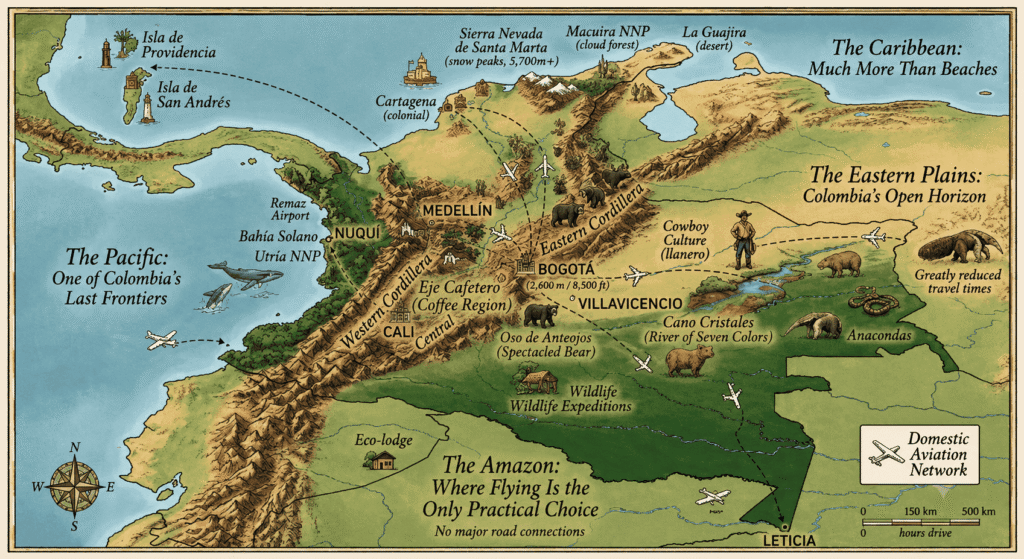
To understand why domestic flights play such a central role in traveling across the country, it helps to begin with a simple map.
Unlike many countries where highways connect broad plains or gently rolling landscapes, Colombia is shaped by dramatic geographic barriers. As the Andes enter the country from the south, they split into three separate mountain ranges the Eastern, Central, and Western Cordilleras. Between them lie deep river valleys, cloud forests, fertile basins, and isolated regions that have shaped settlement, trade, and culture for centuries.
Distance in Colombia is therefore measured by much more than kilometers (or miles). Two places that appear relatively close on a map may be separated by mountain passes, winding roads, or entirely different ecosystems. A journey that seems straightforward can easily become an eight- or ten-hour drive.
And the mountains are only the beginning.
The Amazon: Where Flying Is the Only Practical Choice
Nearly half of Colombia’s territory belongs to the Amazon Basin, one of the most biodiverse regions on Earth.
Unlike many rainforest destinations around the world, much of the Colombian Amazon has never been connected by road to the rest of the country. Communities, nature reserves, and protected forests remain accessible primarily by air and river.
For travelers, destinations such as Leticia offer the opportunity to experience the Amazon responsibly, whether through wildlife expeditions, indigenous cultural experiences, or increasingly sophisticated eco-lodges that combine comfort with conservation.
Here, boarding a plane is not simply a matter of convenience it is the only realistic way to reach one of Colombia’s most extraordinary landscapes.
The Caribbean: Much More Than Beaches
Many visitors imagine Colombia’s Caribbean coast as a single tropical destination. In reality, it contains remarkable geographic contrasts.
To the northeast, La Guajira combines desert landscapes, towering dunes, dry forests, and turquoise waters unlike anywhere else in the country. Nearby, Macuira National Natural Park protects an unexpected cloud forest that rises from the middle of the desert.
Further west, the Sierra Nevada de Santa Marta rises directly from the Caribbean coast to snow-capped peaks above 5,700 meters (18,700 feet), making it the world’s highest coastal mountain range.
Between these landscapes lie Cartagena’s colonial streets, the Rosario Islands, traditional fishing villages, and the coral reefs surrounding Providencia Island. Reaching several of these destinations efficiently almost always involves a domestic flight.
The Pacific: One of Colombia’s Last Frontiers
If the Caribbean feels accessible, Colombia’s Pacific coast feels wonderfully remote.
Covered by dense rainforest and receiving some of the highest levels of rainfall on the planet, this region has remained largely isolated by geography. Roads are limited, and many destinations are connected only by small aircraft or boats.
Places such as Nuquí, Bahía Solano, and Utría National Natural Park offer an entirely different Colombia wild beaches, untouched rainforest, rich marine life, and, between July and October, the unforgettable spectacle of humpback whales arriving to breed along the coast.
For many travelers, the flight itself marks the beginning of the adventure.
The Eastern Plains: Colombia’s Open Horizon
Cross the Andes toward the east and the scenery changes once again.
The Llanos stretch across immense tropical grasslands where cattle ranches, wetlands, winding rivers, and abundant wildlife define the landscape. During the rainy season, vast areas become flooded, while the dry season transforms the region into endless golden savannas.
It is one of the country’s best places to observe wildlife including capybaras, giant anteaters, caimans, anacondas, and hundreds of bird species and to experience Colombia’s cowboy culture, known locally as the llanero tradition.
Although roads connect parts of the region, flying dramatically reduces travel times and opens access to areas that would otherwise require long overland journeys.
Geography Explains the Airplane
Once you understand Colombia’s geography, domestic aviation begins to make perfect sense.
Some of the country’s most rewarding destinations are best explored by road. Places like Villa de Leyva, Barichara, Guatapé, or many areas of the Coffee Region are as much about the journey as the destination itself.
Others tell a different story.
Traveling from Bogotá to Cartagena, Leticia, Nuquí, or even Medellín often means crossing multiple mountain ranges and dramatically different ecosystems. What looks like a short distance on a map may require an entire day by road.
For travelers with ten or fifteen days to explore Colombia, combining carefully chosen road trips with domestic flights is usually the smartest way to experience the country’s extraordinary diversity. In Colombia, flying is not simply about saving time, it is about making more of the time you have.
Why Colombia Became an Aviation Country
For many international travelers, Colombia’s extensive network of domestic flights comes as a surprise. In many countries, flying is simply a faster alternative to driving. In Colombia, aviation became essential because geography left few other options.
Long before the arrival of the Spanish, Indigenous communities had already established networks of footpaths connecting different regions of the territory. These routes supported trade, diplomacy, and cultural exchange, but Colombia’s rugged mountains, dense forests, and vast rivers made long-distance travel slow and physically demanding.
When the Spanish founded Bogotá in 1538, they chose a strategic location on a high plateau in the Eastern Andes, approximately 2,600 meters (8,500 feet) above sea level. The climate was mild, the surrounding land was fertile, and the mountains provided natural protection. It was an ideal place for a colonial capital.
It was also remarkably isolated.
For centuries, reaching Bogotá from the Caribbean coast meant following the Magdalena River the country’s principal transportation corridor before continuing for several days along steep mountain roads. Depending on the season, the journey could take weeks, and sometimes even months.
During the nineteenth century, the newly independent republic attempted to improve connectivity by building railways. Although several important lines were constructed, Colombia’s geography made it difficult to create a truly national rail network. Unlike countries with broad plains, every new railway meant crossing mountains, valleys, and unstable terrain.
Then aviation changed everything.
In 1919, Barranquilla became the birthplace of SCADTA (Sociedad Colombo-Alemana de Transporte Aéreo), widely regarded as the first commercial airline in the Americas and one of the oldest airlines still operating under a successor company anywhere in the world.
The idea was remarkably simple: instead of fighting Colombia’s geography, fly over it.
Early aircraft often followed the Magdalena River as a natural navigation route before connecting inland cities that had previously required days or even weeks of travel. For the first time, mountains that had isolated communities for centuries became obstacles that could be crossed in a matter of hours.
SCADTA would eventually evolve into Avianca, but its greatest legacy was not simply creating an airline. It fundamentally changed how Colombians moved around their own country.
More than a century later, that legacy is still visible. Colombia has expanded its highways, modernized its airports, and improved regional infrastructure, yet domestic aviation remains one of the country’s most important transportation systems.
Today, a flight from Bogotá to Medellín takes about an hour. Bogotá to Cartagena can be reached in around 90 minutes. Even remote destinations such as Leticia, Nuquí, or Bahía Solano rely on air connections that make travel possible in ways that roads never could.
Understanding this history helps explain something many visitors notice during their trip: in Colombia, flying is not a luxury or merely a way to save time. It is the natural consequence of a country whose geography has always demanded a different way of traveling.
How I Usually Recommend Traveling Between Colombia’s Main Destinations
Route | By Road | By Plane | My Recommendation | Why |
Bogotá → Medellín | 9–10 hrs | 1 hr | ✈️ Fly | Saves almost an entire day unless you’re planning a road trip through the Coffee Region. |
Bogotá → Cartagena | 18–20 hrs | 1 hr 30 min | ✈️ Fly | The fastest and most practical option. |
Bogotá → Cali | 9–10 hrs | 1 hr | ✈️ Fly | Ideal for multi-region itineraries. |
Bogotá → Santa Marta | 16–18 hrs | 1 hr 30 min | ✈️ Fly | Greatly reduces travel time. |
Bogotá → Leticia (Amazon) | No road access | ~2 hrs | ✈️ Fly | The Colombian Amazon is accessible only by air. |
Bogotá → Nuquí | No practical road access | ~1 hr 20 min (usually via Medellín) | ✈️ Fly | Dense rainforest and the Pacific coastline make flying the only realistic option. |
Bogotá → Bahía Solano | No practical road access | ~1 hr 20 min (usually via Medellín) | ✈️ Fly | Remote Pacific destination with no road connection. |
Bogotá → Caño Cristales | No direct road route | Seasonal flight | ✈️ Fly | Access is controlled and flights are part of the experience. |
Bogotá → Providencia | No road access | Flight via San Andrés | ✈️ Fly | The island can only be reached by plane. |
Bogotá → Yopal (Los Llanos) | 6–7 hrs | ~1 hr | 🤔 Depends | Fly if you’re short on time; drive if you want to experience the changing landscapes of the Eastern Plains. Keep in mind that the lodges are at least 2 h away from Yopal. |
Bogotá → Villavicencio (Gateway to Los Llanos) | 2–3 hrs | No need | 🚗 Drive | A scenic drive and the natural entrance to the Llanos region. |
Medellín → Guatapé | ~2 hrs |
| 🚗 Drive | The journey is part of the experience. |
Bogotá → Villa de Leyva | 3–4 hrs |
| 🚗 Drive | One of Colombia’s classic road trips. |
Bucaramanga → Barichara | ~3 hrs |
| 🚗 Drive | The drive through Santander is worth experiencing. |
Armenia/Pereira → Salento | 1–1.5 hrs |
| 🚗 Drive | Best explored by road. |
Note: Flight times refer to the time in the air and do not include airport procedures or transfers. Even after accounting for check-in and security, flying is usually the fastest option for traveling between Colombia’s major regions.
Where Flying Isn’t Optional: Colombia’s Most Remote Destinations
One of the most fascinating aspects of traveling in Colombia is that some of its greatest natural wonders cannot be reached by road not because the infrastructure is incomplete, but because geography has always dictated a different way of traveling.
Rainforests, Pacific beaches, remote islands, and protected national parks remain naturally isolated. Reaching them almost always begins with a flight, and in many cases, that flight is the first step of the adventure.
The Colombian Amazon: Entering the World’s Largest Rainforest
The Colombian Amazon covers nearly half of the country’s territory, yet much of it remains inaccessible by road. Instead of highways, rivers have always served as the region’s natural transportation network.
The city of Leticia, located on the banks of the Amazon River at Colombia’s southernmost border, is the country’s gateway to the rainforest. There is no road connecting Leticia to the rest of Colombia. Every traveler arrives by air before continuing by boat into one of the world’s most biodiverse ecosystems.
Whether you’re interested in wildlife, birdwatching, indigenous cultures, or luxury eco-lodges deep in the rainforest, every Amazon journey begins the same way: with a flight from Bogotá.
Best way to get there: Direct flight from Bogotá to Leticia.
Nuquí and Bahía Solano: Colombia’s Untamed Pacific
If the Amazon feels remote, Colombia’s Pacific coast feels almost untouched.
Hidden behind the mountains of the Chocó region, Nuquí and Bahía Solano are surrounded by dense rainforest, wild beaches, waterfalls, and some of the richest marine ecosystems in the eastern Pacific.
Between July and October, humpback whales arrive to breed along the Colombian coast, turning the region into one of South America’s finest whale-watching destinations.
Road access remains extremely limited, making regional flights the only practical way to visit.
Nearby, Utría National Natural Park protects mangroves, coral reefs, tropical rainforest, and quiet bays where nature remains the main attraction.
Best way to get there: Fly to Medellín and connect with a regional flight operated by SATENA or Clic Air.
Caño Cristales: The River of Seven Colors
Deep within the Serranía de la Macarena lies one of Colombia’s most extraordinary natural wonders.
Known as the “River of Seven Colors,” Caño Cristales owes its vibrant shades of red, yellow, green, blue, and black to aquatic plants that bloom during specific months of the year.
Access to the river is carefully regulated to protect this fragile ecosystem. Visitors typically fly to La Macarena before continuing with local transportation and certified guides.
The journey itself reflects what makes Colombia so unique: some of its most spectacular places remain extraordinary precisely because they are difficult to reach.
Best way to get there: Seasonal regional flights to La Macarena.
Providencia: Colombia’s Hidden Caribbean
Located more than 700 kilometers (435 miles) north of mainland Colombia, Providencia feels like a world of its own.
Part of the Seaflower Biosphere Reserve, the island is surrounded by one of the largest coral reef systems in the Caribbean and has preserved a distinct Raizal culture, a slower pace of life, and a remarkable sense of tranquility.
Unlike many Caribbean destinations built around large resorts, Providencia offers an experience centered on nature, local traditions, and small-scale tourism.
Reaching the island requires a domestic flight from San Andrés, making the journey part of the experience rather than simply transportation.
Best way to get there: Fly to San Andrés and connect with a local flight to Providencia.
Geography Protects Colombia’s Greatest Treasures
These destinations have something important in common.
They remind us that Colombia’s greatest natural treasures are often found in places where geography has protected them for centuries. Mountains, rainforests, rivers, and oceans have limited development while preserving extraordinary biodiversity, unique cultures, and landscapes that remain remarkably intact.
For travelers, that means flying is not the opposite of adventure.
It is often where the adventure begins.
And in Colombia, it is sometimes the only way the adventure is possible.
Colombia’s Main Airlines: Which One Should You Choose?
One of the questions I hear most often is, “Which is the best airline in Colombia?”
My answer is always the same: there isn’t one.
The best airline is the one that fits your itinerary.
When we design trips at Circling Colombia, we rarely book every flight with the same airline. Instead, we compare routes, schedules, connection times, and overall convenience to create the most efficient journey possible. Sometimes that means flying with Avianca on one route, LATAM on another, and a regional airline for destinations that larger carriers simply don’t serve.
The goal isn’t to stay loyal to one airline. The goal is to spend less time traveling and more time experiencing Colombia.
Avianca
As Colombia’s flag carrier, Avianca operates the country’s largest domestic network. It offers frequent flights between Bogotá and virtually every major destination, including Medellín, Cartagena, Cali, Santa Marta, Pereira, Armenia, Bucaramanga, Leticia, and many more.
For international visitors arriving on long-haul flights, Avianca often provides the widest range of onward domestic connections.
LATAM Airlines Colombia
LATAM also operates an extensive domestic network and is an excellent alternative for most popular routes. It serves destinations such as Medellín, Cartagena, Cali, Santa Marta, San Andrés, Pereira, Armenia, and many others.
In many cases, LATAM’s schedules complement Avianca’s, making it worthwhile to compare both airlines before booking. Depending on the route and travel dates, one may offer a more convenient departure time or a better fare than the other.
Wingo
Wingo has established itself as Colombia’s leading low-cost airline, but its network extends well beyond a handful of popular routes.
The airline connects Bogotá with destinations such as Cartagena, Medellín, Cali, Santa Marta, Pereira, Barranquilla, and several international destinations across Latin America and the Caribbean.
If the schedule fits your plans, Wingo often represents excellent value. Just remember that, like most low-cost airlines, baggage allowances are usually more restrictive than on traditional carriers.
SATENA
SATENA was created to connect regions where commercial aviation was limited or nonexistent, and it continues to play that role today.
Many of Colombia’s most extraordinary destinations including Nuquí, Bahía Solano, Mitú, Inírida, and several smaller communities depend on SATENA’s network.
If your itinerary includes Colombia’s more remote regions, there is a good chance SATENA will be part of your journey.
Clic Air
Clic Air specializes in regional connectivity, operating smaller aircraft to destinations that larger airlines often do not serve.
Its network includes places such as Nuquí, Bahía Solano, Tolú, and other regional airports, making it an important option for travelers exploring beyond Colombia’s main tourist destinations.
Because both SATENA and Clic Air operate smaller fleets with fewer daily departures, I strongly recommend booking these flights well in advance, particularly during whale-watching season, school holidays, and other peak travel periods.
Private Charter Flights
For travelers seeking maximum flexibility, Colombia also has a well-developed network of private charter operators.
Private aircraft can dramatically simplify complex itineraries, allowing direct access to remote destinations while avoiding multiple commercial connections. Although considerably more expensive than scheduled flights, charter services are often the preferred choice for luxury travelers, photographers, families, or groups with limited time.
Practical Tips for Domestic Flights in Colombia
Choose the itinerary, not the airline. Travelers sometimes ask whether they should book every flight with the same airline. In my experience, doing so often results in less convenient schedules or longer travel days.
Instead, I recommend looking at your itinerary as a whole. Avianca may offer the best morning departure, LATAM the most convenient return, Wingo the best schedule for another route, while SATENA or Clic Air may be the only practical way to reach a remote destination.
In Colombia, the smartest itinerary is usually built by combining the strengths of several airlines, not by remaining loyal to just one.
What to Expect at Colombia’s Airports
If you’re used to flying within Europe or the United States, you’ll probably find domestic airports in Colombia refreshingly straightforward.
While every airport has its own character, the overall experience is generally efficient and uncomplicated. One thing that surprises many international travelers is how compact most Colombian airports are. Even at the country’s busiest terminals, it’s unusual to spend long periods walking between security checkpoints and departure gates.
Unlike some of the world’s largest airports, you won’t find trains connecting terminals or shuttle buses transporting passengers between distant gates. In most cases, everything is within a comfortable walking distance, making connections and departures much less stressful.
Bogotá: El Dorado International Airport
Most domestic journeys begin at Bogotá’s El Dorado International Airport, Colombia’s largest aviation hub and one of the busiest airports in Latin America.
Despite handling millions of passengers every year, I generally find El Dorado surprisingly efficient. Domestic and international operations are well organized, making connections relatively straightforward for travelers arriving from overseas.
For most domestic flights, I recommend arriving about one hour before departure. During Easter, Christmas, school holidays, or major festivals, allowing an additional 30 to 60 minutes provides extra peace of mind.
Medellín: An Airport Outside the City
One of the biggest surprises for first-time visitors is that Medellín’s main airport isn’t actually in Medellín.
José María Córdova International Airport is located in the municipality of Rionegro, approximately 35 kilometers (22 miles) from El Poblado. Depending on traffic, the journey usually takes between 40 minutes and one hour.
If you’re planning to visit Guatapé, eastern Antioquia, or nearby coffee farms, this location can actually work to your advantage, as many of these destinations are closer to the airport than to Medellín’s city center.
Cartagena: Small Airport, Big Demand
Cartagena’s Rafael Núñez International Airport is one of the easiest airports in Colombia for visitors.
Located just minutes from the Walled City and Bocagrande, transfers are quick and uncomplicated. However, because Cartagena is one of Colombia’s most popular destinations, the terminal can become busy during weekends, holidays, and the high season.
If you’re departing from Cartagena, I usually recommend arriving a little earlier than you normally would.
Regional Airports: Where the Adventure Begins
One of my favorite things about flying around Colombia is seeing airports become smaller as the destinations become more remote.
Airports in places such as Leticia, Nuquí, Bahía Solano, and La Macarena are simple, functional, and perfectly adapted to the communities they serve. Don’t expect large shopping areas or premium lounges. Instead, expect friendly terminals, short walking distances, and spectacular scenery almost as soon as you step off the plane.
For many travelers, these regional airports are not simply places of arrival they’re the beginning of the experience.
Practical Tips for Domestic Flights in Colombia
After organizing itineraries across Colombia for many years, these are the recommendations I share most often with travelers:
- Arrive with enough time before your flight. For most domestic departures, one hour is usually enough. During Easter, Christmas, school holidays, and major festivals, I recommend allowing a little extra time.
- Most airports are compact and easy to navigate. You won’t need trains, shuttle buses, or long walks between terminals. From check-in to your departure gate, everything is generally within easy walking distance.
- Weather can occasionally affect flight schedules. Colombia’s rainy seasons particularly April, early May, October, and November sometimes bring delays, especially at regional airports or destinations surrounded by mountains. If you have a tight connection or an important activity planned after landing, it’s always wise to leave a little flexibility in your schedule.
- Morning flights are often the most reliable. Weather conditions tend to be more stable earlier in the day, making early departures a good option when timing matters.
- Choose a window seat whenever possible. Flying over the Andes, the Amazon, or approaching the Caribbean coast offers some of the most spectacular aerial views in South America.
- Book well in advance during Colombian holidays and festivals. Easter, Christmas, Barranquilla Carnival, Medellín’s Flower Festival, and the Cali Fair all generate significant demand, and flights can sell out quickly or become considerably more expensive.
Overall, flying within Colombia is a remarkably smooth experience. Once you know what to expect, domestic airports are easy to navigate, transfers are uncomplicated, and moving between regions becomes one of the simplest parts of exploring the country.
Flying Over Colombia Is Part of the Experience
For me, flying across Colombia has never been just a way of getting from one destination to another.
It is one of the most rewarding parts of the journey itself.
From the ground, Colombia reveals itself one destination at a time. A colonial city, a coffee plantation, a rainforest, a Caribbean beach. Each place feels like its own world.
From the window of an airplane, however, those worlds suddenly begin to connect.
Minutes after departing Bogotá, the city disappears beneath an endless landscape of mountains. The Andes stretch toward the horizon, their ridges folding into one another until they fade beneath the clouds.
On flights crossing the Central Andes, clear skies sometimes reveal the snow-capped volcanoes of Los Nevados National Natural Park. Seeing glaciers rise above tropical valleys is one of those unexpected moments that reminds you how remarkably diverse Colombia really is.
Further south and east, the scenery changes once again.
Rivers begin to replace mountain roads, winding through an immense green canopy that seems to stretch forever. From above, the Amazon doesn’t look like a forest it looks like an ocean of trees.
Approaching the Caribbean, the landscape softens. Mountains gradually give way to turquoise water, white beaches, coral reefs, and islands scattered across the sea.
Flying toward the Pacific offers yet another completely different perspective. Dense rainforest reaches almost to the shoreline, where powerful waves meet one of the most untouched coastlines in the Americas.
Whenever possible, I always encourage travelers to choose a window seat.
Not for the photographs although you’ll probably take plenty but because the view tells a story that no guidebook or map can fully capture.
You begin to appreciate the sheer scale of the Andes, the countless rivers threading through the Amazon, the isolation of the Pacific coast, and the extraordinary diversity packed into a single country.
Some flights become experiences in their own right.
Others quietly prepare you for the destination waiting below.
Either way, looking out of the window is often the first moment when travelers truly understand just how extraordinary Colombia is.
Because in Colombia, the journey doesn’t begin when you land.
Sometimes, it begins the moment the plane leaves the ground.
Before You Book Your Flights
By now, you’ve probably realized that flying around Colombia is remarkably easy. The challenge isn’t finding flights, it’s deciding how to use them to build a trip that feels balanced, enjoyable, and realistic.
After years of designing itineraries across the country, these are the recommendations I find myself sharing most often.
Book Early for Peak Travel Seasons
Domestic flights in Colombia are often excellent value when booked in advance. However, demand increases significantly during major holidays and festivals.
If you’re planning to visit during Holy Week (Semana Santa), Christmas, New Year’s, Barranquilla Carnival, Medellín’s Flower Festival (Feria de las Flores), or the Cali Fair (Feria de Cali), booking your flights several months ahead will usually give you better schedules and more reasonable fares.
Give Yourself Some Flexibility
No itinerary is perfect, and that’s especially true in a country with such varied geography and weather.
If you’re visiting remote destinations or planning several flights within a short period, avoid building an itinerary where every connection depends on everything running exactly on time.
A little flexibility often means a much more relaxed and enjoyable trip.
Pack for the Destination, Not Just the Flight
Not every flight in Colombia is the same.
Routes between Bogotá, Medellín, Cartagena, and other major cities are usually operated with larger aircraft and generous baggage allowances. Regional destinations such as Nuquí, Bahía Solano, La Macarena, Mitú, or Inírida often rely on smaller aircraft with more limited baggage capacity.
Checking your baggage allowance before packing can save both time and unexpected fees at the airport.
Focus on Experiences, Not Destinations
One of the biggest mistakes I see is travelers trying to visit too many places simply because domestic flights make it possible.
Technically, you can visit Bogotá, Medellín, Cartagena, the Coffee Region, and the Caribbean in less than two weeks.
That doesn’t necessarily mean you’ll experience them well.
Colombia rewards travelers who slow down. Spending an extra day hiking in the Coffee Region, exploring Bogotá’s neighborhoods, or enjoying Cartagena after the day-trippers have left often creates far richer memories than adding another destination simply to check it off a list.
A well-planned itinerary isn’t the one with the most flights.
It’s the one that gives you enough time to enjoy every place you visit.
Enjoy the Journey
Domestic aviation has transformed the way people experience Colombia.
In just a few days, it’s possible to wake up in the Andes, have lunch overlooking the Caribbean, explore the Amazon rainforest, or watch the sunset on the Pacific coast.
Used thoughtfully, domestic flights don’t just save time.
They give you the opportunity to experience the extraordinary diversity that makes Colombia unlike anywhere else in the world.
Conclusion
Long before I began designing journeys across Colombia, I realized that this is a country best understood through movement.
Every flight, every mountain pass, every river, and every road tells part of Colombia’s story. What may seem like a simple domestic flight on an itinerary often becomes an opportunity to appreciate the country’s remarkable diversity from the Andes and the Coffee Region to the Amazon, the Caribbean, and the Pacific coast.
Domestic flights aren’t simply about getting from one destination to another.
They’re about creating more time to experience Colombia.
When planned thoughtfully, they allow you to spend less time in transit and more time hiking through cloud forests, sharing a meal with local communities, exploring colonial towns, watching humpback whales, or simply enjoying an extra evening in a place that deserves it.
At Circling Colombia, that’s exactly how we approach every itinerary.
Rather than starting with flights, hotels, or destinations, we start with the traveler. Every itinerary we design is tailor-made, carefully combining domestic flights with scenic road journeys to create a route that matches your interests, travel style, and the time you have available. From selecting the most convenient flight schedules to coordinating transfers and accommodations, every decision is made with one goal in mind: helping you experience more of Colombia while worrying less about logistics.
If you’re planning a trip to Colombia and would like a personalized itinerary, we’d be delighted to help you design a journey that reflects the way you want to travel thoughtfully planned, carefully paced, and filled with meaningful experiences from beginning to end.
The goal isn’t to take more flights. It’s to experience more of Colombia.
Tomás Vargas
Historian | Colombia Travel Specialist & Tour Guide | Founder of Circling Colombia
Frequently Asked Questions
What is the best way to travel between regions in Colombia?
For long distances, domestic flights are the fastest and most convenient option. Colombia has an extensive network of airports connecting major cities and popular tourist destinations, making it easy to travel between regions in just a few hours.
Which airlines operate domestic flights in Colombia?
Several airlines offer domestic routes across Colombia, including Avianca, LATAM Airlines, JetSMART, Wingo, Clic Air, and SATENA. While major airlines connect the country’s largest cities, regional carriers also serve remote destinations such as the Amazon, the Pacific Coast, and smaller towns.
How far in advance should I book domestic flights in Colombia?
For the best fares, it’s recommended to book your domestic flights at least 4 to 8 weeks in advance, especially if you’re traveling during holidays, Christmas, Easter, or Colombia’s peak tourist seasons.
How long are domestic flights in Colombia?
Most domestic flights take between 45 minutes and 2 hours. For example:
- Bogotá to Medellín: approximately 1 hour
- Bogotá to Cartagena: about 1 hour 30 minutes
- Medellín to Santa Marta: around 1 hour 15 minutes
- Bogotá to Pereira: approximately 50 minutes
Flying allows travelers to visit multiple regions without spending long hours on the road.
Can I visit several regions of Colombia in one trip?
Absolutely. Colombia’s domestic flight network makes it easy to combine destinations such as Bogotá, Cartagena, Medellín, the Coffee Region, the Amazon, or the Caribbean Coast in a single itinerary. Even a 7- to 10-day trip can include several different regions.
Do domestic flights in Colombia include checked baggage?
It depends on the airline and the fare you purchase. Budget fares often include only a personal item, while carry-on and checked luggage may require an additional fee. Always check your baggage allowance before booking.
Which airport offers the most domestic connections?
El Dorado International Airport (Bogotá) is Colombia’s largest airport and the country’s main domestic hub. It offers direct flights to nearly every major tourist destination, including Cartagena, Medellín, Pereira, Leticia, San Andrés, Santa Marta, and many others.
Is flying in Colombia safe?
Yes. Colombia’s commercial airlines operate under international aviation safety standards, and flying is considered one of the safest and most efficient ways to travel between regions. Domestic flights are widely used by both locals and international visitors.
Can Circling Colombia help me plan domestic flights?
Yes. At Circling Colombia, we create tailor-made itineraries that include recommendations for the best domestic flight routes, ideal travel schedules, airport transfers, and seamless logistics between destinations. Our goal is to help you make the most of your time while exploring Colombia.